What multiplier for each point in 68 Niu Niu?
What multiplier for each point in 68 Niu Niu? When the red envelope amount doesn't form a special hand, regular cards follow the point-to-multiplier ratio: 1 point equals 1x, 2 points equals 2x, and so on up to 9 points equals 9x. The highest score is 10 points, known as Niu Niu, corresponding to 10x multiplier. Points are calculated by adding the digits in the red envelope amount and taking only the last digit. When both players have regular cards, the player with the higher points wins.
- 1. How many points equal how many times in 68 Niu Niu? 1 to 10 point multiplier reference
- 2. Why does 10 point Niu Niu equal 10x multiplier?
- 3. What are the multipliers for 9 to 5 points respectively?
- 4. What are the multipliers for 4 to 1 points respectively?
- 5. How are point values and multipliers calculated for regular cards?
- 6. How are regular cards compared in size?
- 7. What’s the difference between special card types and standard point multipliers?
- 8. 68 Niu Niu point multiplier FAQs
How many points equal how many times in 68 Niu Niu? 1 to 10 point multiplier reference
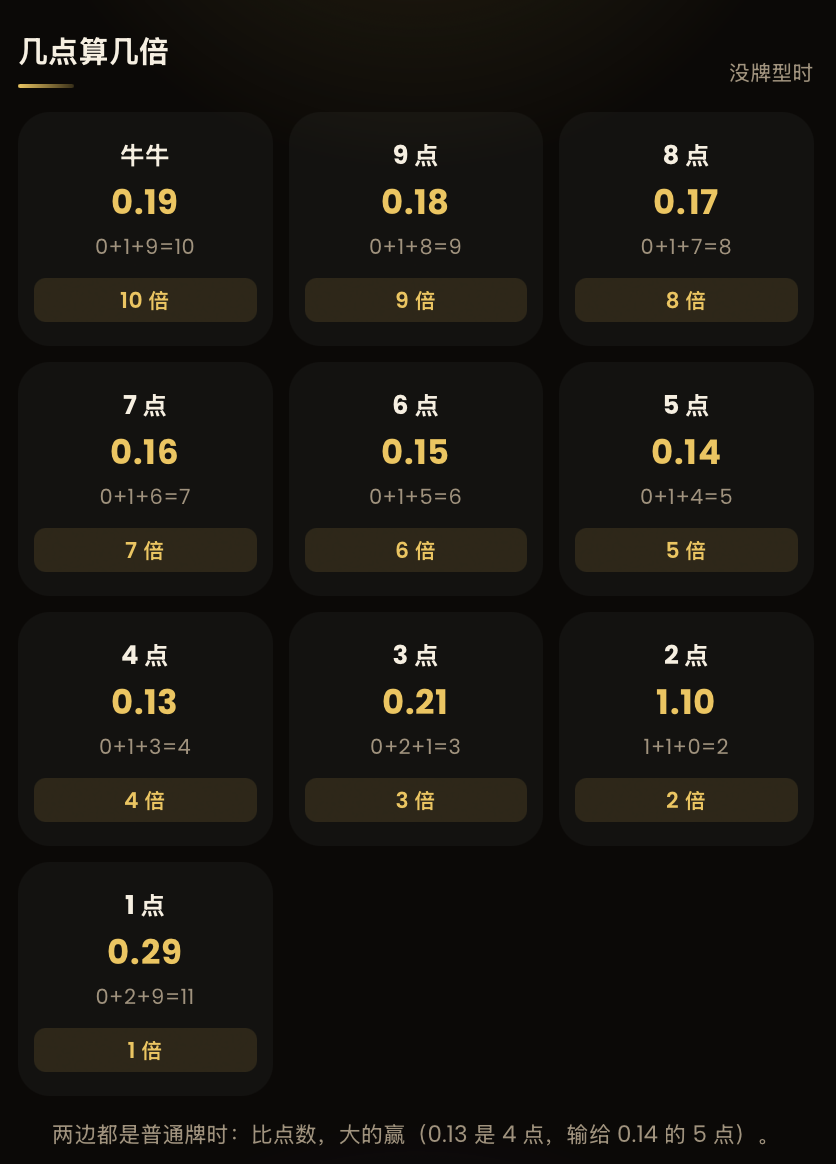
Without forming a special hand, 68 Niu Niu regular cards use a "point equals multiplier" system. Points range from 1 to 10, with corresponding multipliers from 1x to 10x, where 10 points is called Niu Niu, the highest result among regular scores.
10 points Niu Niu: 10x
10 points equals 10x multiplier, which is Niu Niu. For example, the digits in RM0.19 add up to 0 + 1 + 9 = 10, so it's calculated as 10 points Niu Niu, corresponding to 10x.
9 points: 9x
9 points equals 9x multiplier. For example, RM0.18 is calculated as 0 + 1 + 8 = 9, so it's a 9-point hand, corresponding to 9x.
8 points: 8x
8 points equals 8x multiplier. For example, the digits in RM0.17 add up to 8, so by regular card multiplier rules it's 8x.
7 points: 7x
7 points equals 7x multiplier. Taking RM0.16 as an example, 0 + 1 + 6 = 7, so the result is 7 points, 7x.
6 points: 6x
6 points equals 6x multiplier. For example, the digits in RM0.15 add up to 6, so it's a 6-point hand, corresponding to 6x.
5 points: 5x
5 points equals 5x multiplier. For example, the digits in RM0.14 add up to 5, so it's a 5-point hand, 5x multiplier.
4 points: 4x
4 points equals 4x multiplier. For example, RM0.13 is calculated as 0 + 1 + 3 = 4, so it's a 4-point hand.
3 points: 3x
3 points equals 3x multiplier. For example, RM0.21 is calculated as 0 + 2 + 1 = 3, so it's a 3-point hand.
2 points: 2x
2 points equals 2x multiplier. For example, the digits in RM1.10 add up to 1 + 1 + 0 = 2, so the result is 2 points, 2x multiplier.
1 point: 1x
1 point equals 1x multiplier. For example, the digits in RM0.29 add up to 0 + 2 + 9 = 11. Taking only the last digit of the sum, the final result is 1 point, corresponding to 1x.
Why does 10 point Niu Niu equal 10x multiplier?
Regular card points range from 1 to 10. When the digits sum to a last digit of 0, it's treated as 10 points, which is Niu Niu. Since regular cards use the point-equals-multiplier system, Niu Niu corresponds to the highest multiplier of 10x.
Last digit of digit sum is 0
When calculating points, add each digit in the red packet amount. If the sum's units digit is 0, it is not counted as 0 points but is determined as 10-point Niu Niu according to the rules.
RM0.19 is 10-point Niu Niu
Taking RM0.19 as an example, adding the digits gives 0 + 1 + 9 = 10, with a units digit of 0, so the final result is 10-point Niu Niu, corresponding to 10x.
Niu Niu is the highest regular point result
When neither side forms a special hand, 10-point Niu Niu is higher than 9 points through 1 point, making it the highest tier among regular points.
What are the multipliers for 9 to 5 points respectively?
From 9 points to 5 points, the multiplier directly corresponds to the point value with no additional conversion: 9 points = 9x, 8 points = 8x, 7 points = 7x, 6 points = 6x, 5 points = 5x.
9 Points and 8 Points
9 points corresponds to 9x, and 8 points corresponds to 8x. Examples can be found in RM0.18 and RM0.17 respectively, where the sum of digits equals 9 and 8.
7 Points and 6 Points
7 points corresponds to 7x, and 6 points corresponds to 6x. For example, RM0.16 is 7 points, while RM0.15 is 6 points.
5 Points
5 points corresponds to 5x. For example, in RM0.14, adding 0 + 1 + 4 equals 5, so it is calculated as 5x under the regular hand rules.
What are the multipliers for 4 to 1 points respectively?
Lower point regular hands also follow the rule where points correspond directly to multipliers: 4 points = 4x, 3 points = 3x, 2 points = 2x, 1 point = 1x.
4 Points and 3 Points
RM0.13 has a digit sum of 4, making it 4 points and 4x; RM0.21 has a digit sum of 3, making it 3 points and 3x.
2 Points and 1 Point
RM1.10 has a digit sum of 2, making it 2 points and 2x. RM0.29 has a digit sum of 11, taking only the units digit of 1, making it 1 point and 1x.
How are point values and multipliers calculated for regular cards?
Multipliers are based on the point calculation result, so points must be calculated first before finding the corresponding multiplier. The entire process can be summarized as: 'Add all digits in the red packet amount → Take the units digit to determine points → Points correspond to multipliers.'
Step 1: Break down the digits in the red packet amount
First, check the TNG red packet amount you grabbed and extract each digit used for calculation separately. For example, RM0.17 can be broken down into 0, 1, and 7.
Step 2: Add all the digits together
Add all the broken-down digits. For RM0.17, the calculation is 0 + 1 + 7 = 8, so you get 8 points.
Step 3: Determine the multiplier based on points
After getting the points, directly apply the corresponding multiplier. 8 points equals 8x, 5 points equals 5x, 1 point equals 1x; if the units digit is 0, calculate as 10-point Niu Niu, corresponding to 10x.
How are regular cards compared in size?
When neither side forms special hands such as Bao Zi, Man Niu, Fan Shun, Shun Zi, Dui Zi, or Jin Niu, regular hand rules are used to compare points. The higher the points, the stronger the regular hand.
Regular cards compare by points first
When both sides have regular cards, directly compare the calculated points. For example, RM0.13 equals 4 points, while RM0.14 equals 5 points, so 5-point RM0.14 beats 4-point RM0.13.
10 points beats 9 points
Regular points range from 1 point up to 10 points, with 10-point Niu Niu being the highest. When both sides have regular cards, 10 points beats 9 points, 9 points beats 8 points, and so on.
Compare amount if points are tied
If both sides have regular cards with the same points, compare the red packet amounts. If amounts are also equal, it's treated as a draw and the principal is returned.
What's the difference between special card types and standard point multipliers?
1 to 10x applies to regular points with no special hand types. If a red packet amount forms a special hand type, follow the hand type rules first instead of continuing with 1 to 10x regular multipliers.
Special hand types are evaluated first
After grabbing a red packet, first check if it forms a Leopard, Full Niu, Reverse Straight, Straight, Pair, or Golden Niu. Once a special hand type is formed, handle it according to the hand type rank and corresponding multiplier.
Special hand types correspond to 11 to 18x
Under the current hand type rules: Golden Niu is 11x, Pair is 12x, Straight is 13x, Reverse Straight is 14x, Full Niu is 15x, Leopard is 18x.
Only check 1 to 10 points if no special hand type
Only when no special hand type is formed do you determine by regular points, using the 1-point 1x to 10-point 10x correspondence.
68 Niu Niu point multiplier FAQs
How many times is 1 point worth in 68 Niu Niu?
1 point corresponds to 1x. For example, RM0.29 adds up to 11; taking the ones digit gives 1 point, which corresponds to 1x.
How many times is 5 points worth?
5 points corresponds to 5x. Regular cards use a point-to-multiplier ratio.
How many times is 8 points worth?
8 points corresponds to 8x. For example, RM0.17 adds up to 8, so it's 8 points and 8x.
How many times is 9 points worth?
9 points corresponds to 9x. For example, RM0.18 adds up to 9, so it corresponds to 9x.
How many times is Niu Niu worth?
Niu Niu is 10 points, corresponding to 10x, and is the highest regular point value without special hand types.
Why is 11 equal to 1 point when digits are added?
Because point calculation only takes the ones digit of the total. The ones digit of 11 is 1, so the final result is 1 point, corresponding to 1x.
Do special card types use point multipliers?
No, they don't use standard point multipliers. When special card types appear, judgment is based on the corresponding card type and its multiplier; standard multipliers of 1 to 10 points are only used when there are no special card types.
How is the winner decided when both sides have regular cards?
When neither side has special card types, points are compared and the higher point value wins. For example, 4 points with RM0.13 loses to 5 points with RM0.14.
Continue viewing 68 Niu Niu detailed gameplay rules
After understanding the standard multipliers for 1 to 10 points, you can continue to view the complete rules including Banker/Player, card types, water rules, house cut, rebates and special cases.