68 Niu Niu Hand Quick Guide
68 Niu Niu hands are the key rules for deciding who wins a red packet round. After grabbing a TNG red packet, you don't just calculate the regular points — you first check whether the amount forms a special hand. From highest to lowest, the hands are Triple, Full Niu, Reverse Straight, Straight, Pair and Golden Niu, paying 18x down to 11x. When a special hand appears, hands are compared first; regular points only decide the result when there is no special hand.
- 1. 68 Niuniu Hand Rankings: From Leopard to Golden Bull
- 2. Leopard: The Top Hand, With Three Identical Digits
- 3. Full Bull: The Red Packet Amount Is a Whole Number
- 4. Reverse Straight: Digits Descend in Sequence
- 5. Straight: Digits Ascend in Sequence
- 6. Pair: The Last Two Digits of the Red Packet Amount Match
- 7. Golden Bull: The Red Packet Amount Starts and Ends With 0
- 8. How Do Special Hands Compare With Regular Points?
- 9. 68 Niuniu Hand FAQ
68 Niuniu Hand Rankings: From Leopard to Golden Bull
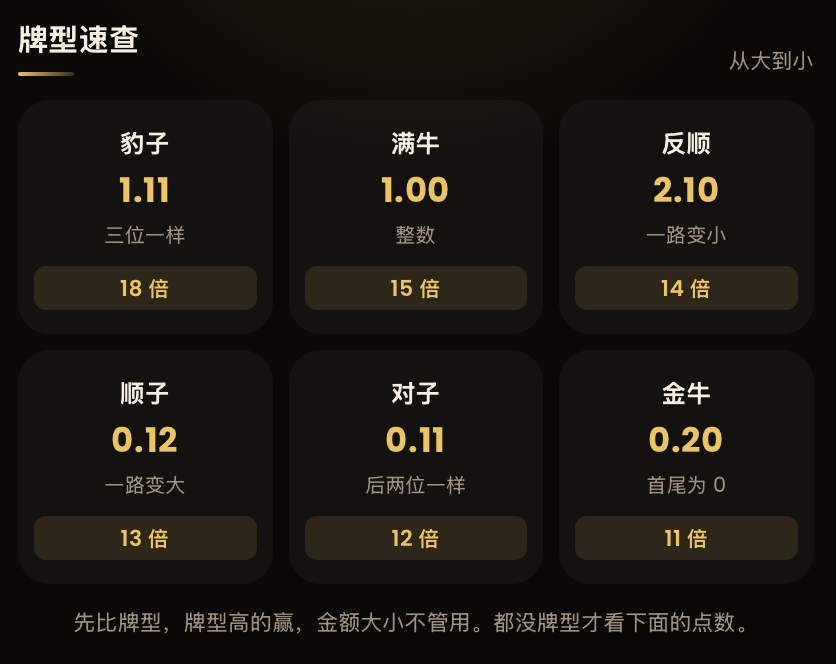
68 Niu Niu has six special hands that are identified first. Ranked from highest to lowest, the order is "Triple > Full Niu > Reverse Straight > Straight > Pair > Golden Niu". The higher-ranked hand wins, and regular points are not needed to settle the result between two different hands.
Triple: 18x
Triple ranks first in the hand order and pays 18x, making it the highest of the six special hands.
Full Niu: 15x
Full Niu ranks right after Triple and pays 15x, beating Reverse Straight, Straight, Pair and Golden Niu in hand comparisons.
Reverse Straight: 14x
Reverse Straight pays 14x. It ranks below Full Niu but above Straight, Pair and Golden Niu.
Straight: 13x
Straight pays 13x and ranks fourth in the current hand order, above Pair and Golden Niu.
Pair: 12x
Pair pays 12x and ranks after Straight but before Golden Niu.
Golden Niu: 11x
Golden Niu pays 11x and is the lowest of the six special hands, but when it appears it is still a special hand that is judged before regular points.
Leopard: The Top Hand, With Three Identical Digits
A Triple is all about the three digits in the red packet amount being identical. For example, the digits in RM1.11 are 1, 1, 1 — all three match, so it forms a Triple.
Triple example: RM1.11
All three digits in RM1.11 are 1, meeting the "three of a kind" condition, so it counts as a Triple.
Triple pays 18x
Triple pays 18x and sits at the top of the current special hands. When compared with any other hand, Triple takes priority.
Full Bull: The Red Packet Amount Is a Whole Number
A Full Niu is judged by the red packet amount being a whole number — that is, having no actual decimal part. Following the quick-guide example, RM1.00 is a Full Niu.
Full Niu example: RM1.00
RM1.00 is a whole-number amount, so it meets the Full Niu condition.
Full Niu pays 15x
Full Niu pays 15x, ranking second only to Triple among the six special hands and above Reverse Straight, Straight, Pair and Golden Niu.
Reverse Straight: Digits Descend in Sequence
A reverse straight is when the digits in the red packet amount run in a continuous descending order — each digit smaller than the last. RM2.10 in the Card Type Guide is an example of a reverse straight.
Reverse straight example: RM2.10
The digits in RM2.10 are 2, 1, 0 — arranged in descending order — so it forms a reverse straight.
Reverse straight pays 14x
A reverse straight pays 14x and ranks third in the card type hierarchy — below Triple and Full Bull, but above Straight, Pair and Golden Bull.
Straight: Digits Ascend in Sequence
A straight is the opposite of a reverse straight: the digits in the red packet amount run in a continuous ascending order. The Card Type Guide uses RM0.12 as its straight example.
Straight example: RM0.12
The digits in RM0.12 are 0, 1, 2 — rising all the way — so it qualifies as a straight.
Straight pays 13x
A straight pays 13x and ranks right after Reverse Straight in the special card type order, while beating Pair and Golden Bull.
Pair: The Last Two Digits of the Red Packet Amount Match
A pair is decided by the last two digits of the red packet amount being the same. For example, the last two digits of RM0.11 are both 1, so it counts as a pair.
Pair example: RM0.11
The last two digits of RM0.11 are 1 and 1, meeting the "last two digits match" condition, so it is judged a pair.
Pair pays 12x
A pair pays 12x and ranks below Straight but above Golden Bull. If both sides have a pair, the pair-versus-pair comparison rules decide the winner.
How are tied pairs compared?
When both sides have a pair, compare the last two digits that form the pair first — for example, 88 beats 66. If the pair digits are the same, compare both sides' points next.
Golden Bull: The Red Packet Amount Starts and Ends With 0
A Golden Bull is identified by the first and last digits of the red packet amount being 0. RM0.20 in the Card Type Guide is arranged as 0, 2, 0, so it meets the Golden Bull condition.
Golden Bull example: RM0.20
The first and last digits of RM0.20 are both 0, so it forms a Golden Bull.
Golden Bull pays 11x
A Golden Bull pays 11x and ranks last among the six current special card types. Even so, when compared with an ordinary result that has no special card type, the card type rules still apply first.
How Do Special Hands Compare With Regular Points?
In 68 Niu Niu, check the card type first when deciding who wins. If a special card type is formed, compare by card type rank first; only when neither side has a special card type do you move on to comparing ordinary points. So don't just count the red packet points and overlook the card type.
Step 1: Identify the card type
After grabbing a red packet, check whether the amount meets the conditions for Triple, Full Bull, Reverse Straight, Straight, Pair or Golden Bull. If it forms one of these card types, judge it by the corresponding card type rank.
Different hand types are ranked directly
When each side has a different special hand, the order is Triple > Full Niu > Reverse Straight > Straight > Pair > Golden Niu. The higher-ranked hand wins.
No special hand? Compare points
If neither side forms a special hand, the winner is decided by the red packet amount's point value. Add up the digits of the amount and take the last digit; a last digit of 0 counts as 10-point Niu Niu.
Same points? Compare amounts
For regular hands, points are compared first. If both sides have the same points, the red packet amounts are compared. If the amounts are also equal, the round is a draw and the stake is refunded.
68 Niuniu Hand FAQ
What are the special hands in 68 Niu Niu?
There are currently six special hands: Triple, Full Niu, Reverse Straight, Straight, Pair and Golden Niu.
How are 68 Niu Niu hands ranked from highest to lowest?
From highest to lowest: Triple, Full Niu, Reverse Straight, Straight, Pair, Golden Niu.
Which hand is the highest?
Triple is the highest, paying 18x. It applies when all three digits of the red packet amount are the same, such as RM1.11.
What is Full Niu?
Full Niu means the red packet amount is a whole number, such as RM1.00. It pays 15x and ranks just below Triple.
What's the difference between Reverse Straight and Straight?
The main difference is the direction of the digits. A Reverse Straight counts down, such as RM2.10, while a Straight counts up, such as RM0.12.
How is a Pair determined?
A Pair is when the last two digits of the red packet amount are the same, such as RM0.11. A Pair pays 12x.
How is a Golden Niu determined?
A Golden Niu is when the first and last digits of the red packet amount are 0, such as RM0.20. It pays 11x.
Which is compared first, hand or points?
Hands are compared first. The higher hand wins; points are only used when neither side has a special hand.
How are two Pairs compared?
When both sides have a Pair, the last two paired digits are compared first, so 88 beats 66. If the pair digits are the same, points are compared.
Learned the Hands? Explore the Full Rules Next
Once you know the ranking of Triple, Full Niu, Reverse Straight, Straight, Pair and Golden Niu, keep reading for detailed rules on points, multipliers and banker–player settlement.