
How do you play a round of 68 NiuNiu?
How do you play a round of 68 NiuNiu? The basic process breaks down into three stages: first, choose to bid for the banker role or place a bet as a player; next, wait for the system to send out TNG red packets in the group and join in grabbing them; finally, calculate points and identify hand types based on the red packet amounts you've grabbed, then compare results between the banker and each betting player to settle the round. Master these three stages and you'll quickly understand how a round of 68 NiuNiu works.
- 1. How do you play one round of 68 牛牛? Understand it quickly in three steps
- 2. Step 1: Grab the banker position to become the banker or place a bet as the player
- 3. Step 2: The system distributes TNG red packets and begins the grabbing phase
- 4. Step 3: Calculate points and hand type, then compare
- 5. What do the banker and player each do in one round?
- 6. 68 牛牛 common questions about one round gameplay
How do you play one round of 68 牛牛? Understand it quickly in three steps
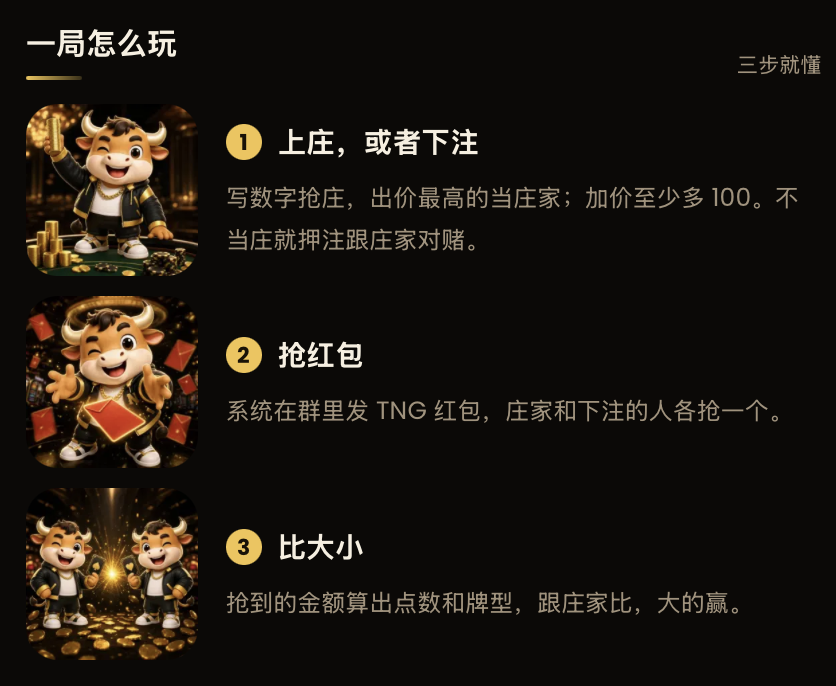
A round of 68 NiuNiu follows the sequence of "become banker or bet → grab TNG red packets → compare hands." At the start, confirm the banker and player roles, then all participants grab the system's red packets. Use the red packet amounts to form the round's points and hand types, and finally the banker compares results with each betting player.
Step 1: Become banker or place a bet
At the start, the banker auction takes place. Players wanting to be banker participate in bidding by entering amounts, with the highest bidder becoming the banker for that round; players not bidding for banker can choose to bet as a player and wager against the banker.
Step 2: Grab TNG red packets
Once the banker is set and players have placed their bets, the system sends out TNG red packets in the 68 NiuNiu group. Both the banker and betting players each grab one red packet and use their amount as the basis for the next calculation.
Step 3: Calculate points and hand types, then compare
After grabbing red packets, calculate your points based on your amount and check if you've formed a special hand type. Each player's result is compared against the banker's using the hand type and points rules to determine the round's winner.
Step 1: Grab the banker position to become the banker or place a bet as the player
At the start of each round, players first need to choose their role. You can bid in the banker auction to become banker, or skip bidding and bet as a player instead. The banker will compare results separately with each betting player in that round.
Want to be banker? Enter a bid amount
To bid for banker, enter a number to participate in the auction. The highest bidder becomes banker. Based on the current rules, the minimum bid increment is 100, so you'll need to decide whether to keep bidding based on the current auction.
Not bidding for banker? Bet as a player instead
Players who don't become banker can choose to bet and participate as a player. After placing your bet, you'll grab a red packet in the next phase and compare your result against the banker's.
No bet? You don't participate in this round's settlement
Players can also choose not to bet. Betting players who skip the round won't enter the win/loss settlement with the banker.
Step 2: The system distributes TNG red packets and begins the grabbing phase
Once the banker is confirmed and players have bet, the game moves to the red packet grabbing phase. The system sends out TNG red packets in the group, and the banker plus all betting players each grab one.
Red packets are sent by the system in the group
TNG red packets are sent by the system in the 68 NiuNiu group. Participants grab them during the designated phase—you don't need to create red packets yourself for comparing hands.
Banker and betting players each grab one
Both the banker and all betting players must grab a red packet. Everyone gets a different amount, and that amount becomes the basis for calculating points and identifying hand types.
Your grabbed amount is used to compare hands next
The red packet amount isn't just about who grabbed the most—you need to calculate points and identify hand types using 68 NiuNiu rules, then determine the final winner.
Step 3: Calculate points and hand type, then compare
After grabbing red packets, the round enters the win/loss determination phase. The system generates corresponding points and hand types from the red packet amounts, then each player compares their result against the banker's. You'll need to consider both special hand types and regular point rules when comparing.
First, calculate points based on the red packet amount
Red envelope amounts are converted to corresponding points using 68 Niu Niu's point calculation method. Players can further review the points calculation guide to understand how red envelope amounts translate to 1 to 10 points.
Then determine if a special hand is formed
In addition to regular points, red envelope amounts may also form special hands such as Leopard (豹子), Full Niu (满牛), Reverse Straight (反顺), Straight (顺子), Pair (对子), and Golden Niu (金牛). When a special hand appears, comparison must follow the corresponding hand rules.
Each player compares with the banker separately
In each round, it is not player-versus-player comparison, but rather each betting player compares individually with the banker. After determining the result by hand type and points, the corresponding win/loss settlement is completed.
Same results are handled as a tie
When both sides have the same hand type, same points, and same amount, it is treated as a tie and the original stake is returned, avoiding forced determination of a winner based solely on matching results.
What do the banker and player each do in one round?
The banker and players participate in the same red envelope grab and comparison process, but their roles in the round differ. The banker serves as the comparison benchmark for all betting players, while each player settles independently with the banker based on their own bet and red envelope result.
Banker compares with all betting players
After successfully claiming the banker role, the banker enters the round and competes individually with all participating betting players. Each player's result is compared independently with the banker's.
Players bet first, then participate in card comparison
Players must complete their bet first, then participate in grabbing the TNG red envelope. After the red envelope results form points and a hand type, they compare with the banker's result.
Every round centers on banker-versus-player comparison
Regardless of how many players participate, the core relationship remains "banker versus player." Understanding this makes it easier to grasp the connections between betting, grabbing red envelopes, and final settlement.
68 牛牛 common questions about one round gameplay
What are the main steps in a round of 68 Niu Niu?
There are three main stages: first, claim the banker role through bidding or place a bet as a player; then, grab the TNG red envelope issued by the system; finally, compare hand strengths based on the points and hand type formed by the red envelope amount.
How do I become the banker in 68 Niu Niu?
Players can bid by entering a number during the banker-claiming phase, with the highest bidder becoming the banker for that round. In the current rules, the minimum bid increment is 100.
What if I don't want to be the banker?
Players who choose not to be the banker can place a bet as a player. After completing their bet, they participate in grabbing the red envelope and use their result to compare with the banker's.
Do I need to settle if I don't place a bet?
No. Players who choose not to place a bet do not participate in the win/loss settlement of that round.
Who sends out the TNG red envelope?
The red envelope is sent by the system in the 68 Niu Niu interaction group, with both the banker and participating betting players each grabbing one.
Does a larger red envelope amount guarantee a win?
Not necessarily. The red packet amount must first be calculated for points and hand type according to the rules, then compared with the banker's hand. Therefore, the outcome cannot be determined solely by the total red packet amount.
What do you compare first in 68 牛牛?
You must first determine if a hand type is formed, then compare according to hand type and points rules. If both final results are identical, it is treated as a tie.
Learn more about 68 牛牛 gameplay
After mastering the banker selection, betting, grabbing TNG red packets, and hand comparison process in a round, you can continue to learn points calculation, hand type rankings, multipliers, and detailed game rules.